
The fifty-ninth session of the Japanese Politics Online Seminar Series (JPOSS) took place on April 9, 2026. Saori Katada (University of Southern California) chaired the seminar and moderated the Q&A session.
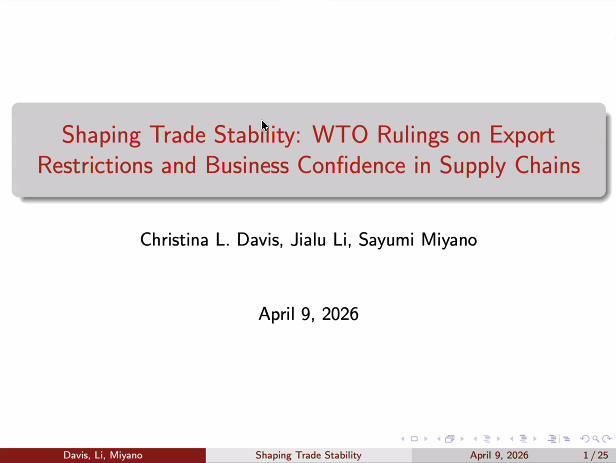
Christina Davis (Harvard University) presented a paper, co-authored with Jialu Li (Independent Researcher) and Sayumi Miyano (Osaka University), examining the effects of WTO rulings and state compliance on business managers. As the rules-based trade order has come under strain in recent years, the authors present original survey experimental evidence on the utility of multilateral frameworks in response to rules violations. Leverage the context of Japanese firms that are heavily exposed to China’s trade behavior, the authors executed a between-subjects survey experiment featuring four vignettes: WTO’s ruling on China’s rules violation, the ruling and China’s compliance, China’s unilateral action, and a neutral statement on WTO principles. The survey was fielded to a sample of 2,100 business managers with decision-making power in medium- to large-sized Japanese firms. The findings show that business managers reported stronger confidence in China’s supply chain reliability when informed about China’s compliance as opposed to only its violations. Respondents in the compliance treatment group also reported stronger confidence than those in the group that learned about China’s unilateral decision regarding the same behavior. At the same time, the results also reveal limitations 0f the multilateral framework. First, the authors found no evidence of spillover effects on confidence in the supply chain reliability of other states, specifically US and Indonesia, though these baseline measures were considerably higher across all vignette groups. Second, the effect varied across industries, which suggests that managers in some industries had opinions that were harder to shift.
Iain Osgood (University of Michigan) and Gregory Shaffer (Georgetown University Law Center) offered comments on the theoretical outcome of interest, the varying nature of the information signals across vignettes, and the framing of the paper. During the Q&A, participants furthered discussion on the goals of China’s actions and possible strategic considerations, the effects related to alternative forms of violations, and suggestions for future studies.
The organizers would like to thank the presenters, discussants, and participants, as well as the staff at the Harvard Program on U.S.-Japan Relations, who provided administrative support. We look forward to seeing you at the next session of JPOSS: https://jposs.org/.