The fifty-eighth session of the Japanese Politics Online Seminar Series (JPOSS) took place on March 5, 2026. Amy Catalinac (New York University) chaired the seminar and moderated the Q&A session.
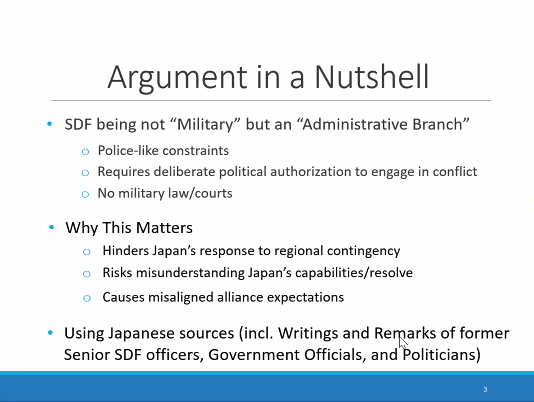
Yuji Idomoto (University of California San Diego) presented a paper on the legal constraints faced by Japan’s Self-Defense Force (SDF). While recent scholarship has focused on Japan’s defense buildup, Idomoto highlights the legal dimension which creates notable differences between the SDF and other militaries. First, Japan’s SDF is one step removed from typical combat readiness during peacetime because it operates under a positive list of authorized actions in response to immediate threats. Transitioning to a negative list used by most other militaries requires explicit cabinet approval through a Defense Operations Order. Second, Idomoto highlights the incompatible incentives faced by SDF personnel in the absence of a military court or legal framework to adjudicate misconduct and clarify individual liability for actions taken during military operations.
Thomas Berger (Boston University) and Paul Midford (Meiji Gakuin University) offered insightful comments on whether the explanation is purely institutional, the role of SDF’s organizational culture, and broader implications of the argument, including on intelligence/state secrecy and the time required for cabinet approval if mobilization is anticipated. During the Q&A, participants furthered discussion on the security dilemma and the security balance created by the SDF’s constraints, possible links to constitutional change and Takaichi’s leadership, and explanations for the persistence of these constraints.
The organizers would like to thank the presenters, discussants, and participants, as well as the staff at the Harvard Program on U.S.-Japan Relations, who provided administrative support. We look forward to seeing you at the next session of JPOSS: https://jposs.org/.