
The sixty-first session of the Japanese Politics Online Seminar Series (JPOSS) took place on July 23, 2026. Daniel Smith (University of Pennsylvania) chaired the seminar and moderated the Q&A session.
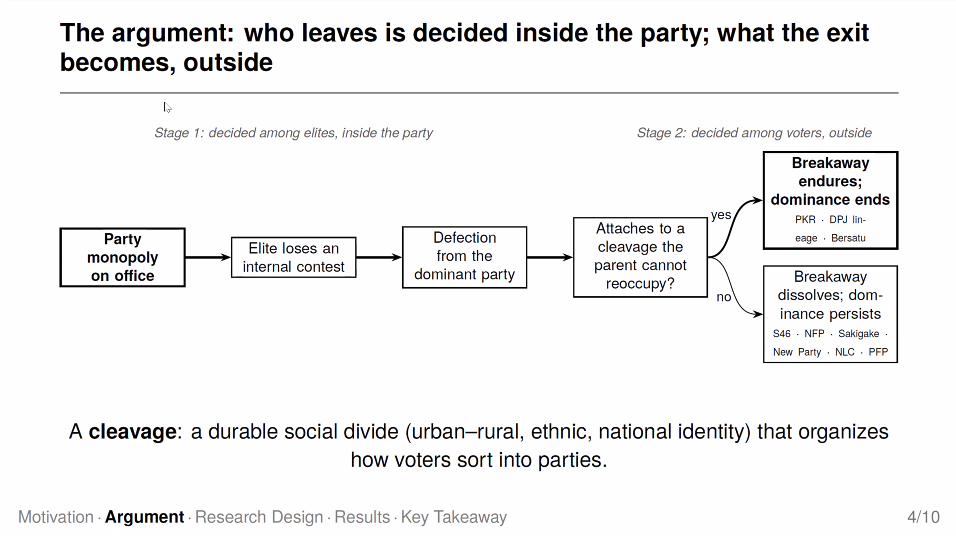
Tyler Rongxuan Chen (University of Michigan) presented his paper examining the pathways of dominant-party system breakdown triggered by intraparty elite struggles. His paper seeks to explain which politicians leave in the aftermath of a struggle and whether their term in opposition endures and achieves the breakdown of the dominant party system. The author argues that politicians’ defection is driven by their electoral weakness while the breakdown of dominance is explained by the emergence of an electoral cleavage. He tests his theory on the cases of Malaysia’s UMNO (~2018), Japan’s LDP (~1993), and Taiwan’s KMT (~2001) in the period leading up to the year where regime change is observed. In the case of Japan, his analysis shows that defection in 1993 correlates with a politician’s membership in the Takeshita faction involved in the power struggle as well as the politician’s intraparty ranking in district votes. He proceeds to argue that the defecting group led by Ozawa succeeded in finding a cleavage in the urban-rural divide, leading to the opposition party’s subsequent survival and success.
Ko Maeda (University of North Texas) and Ora John Reuter (University of Wisconsin, Milwakee) offered insightful comments on the author’s approach to operationalizing the concepts and suggestions to sharpen the theory. During the Q&A, participants raised suggestions for alternative factors in the strategic calculus of LDP politicians and modeling considerations, such as district magnitude and group-level dependence of the decisions.
The organizers would like to thank the presenters, discussants, and participants, as well as the staff at the Harvard Program on U.S.-Japan Relations, who provided administrative support. We look forward to seeing you at the next session of JPOSS: https://jposs.org/.